
The Sun’s outer atmosphere may have a dust problem—and that dust might be heating it up.
A new study suggests that tiny charged grains near the Sun can change how energy moves through the corona, the vast outer atmosphere that reaches millions of degrees while the visible solar surface stays near 5,500° Celsius. It’s like the air around a lit match was much hotter than the match itself.
This temperature discrepancy, where a region further from the core is up to 300 times hotter, is a major astrophysics puzzle called the coronal heating problem
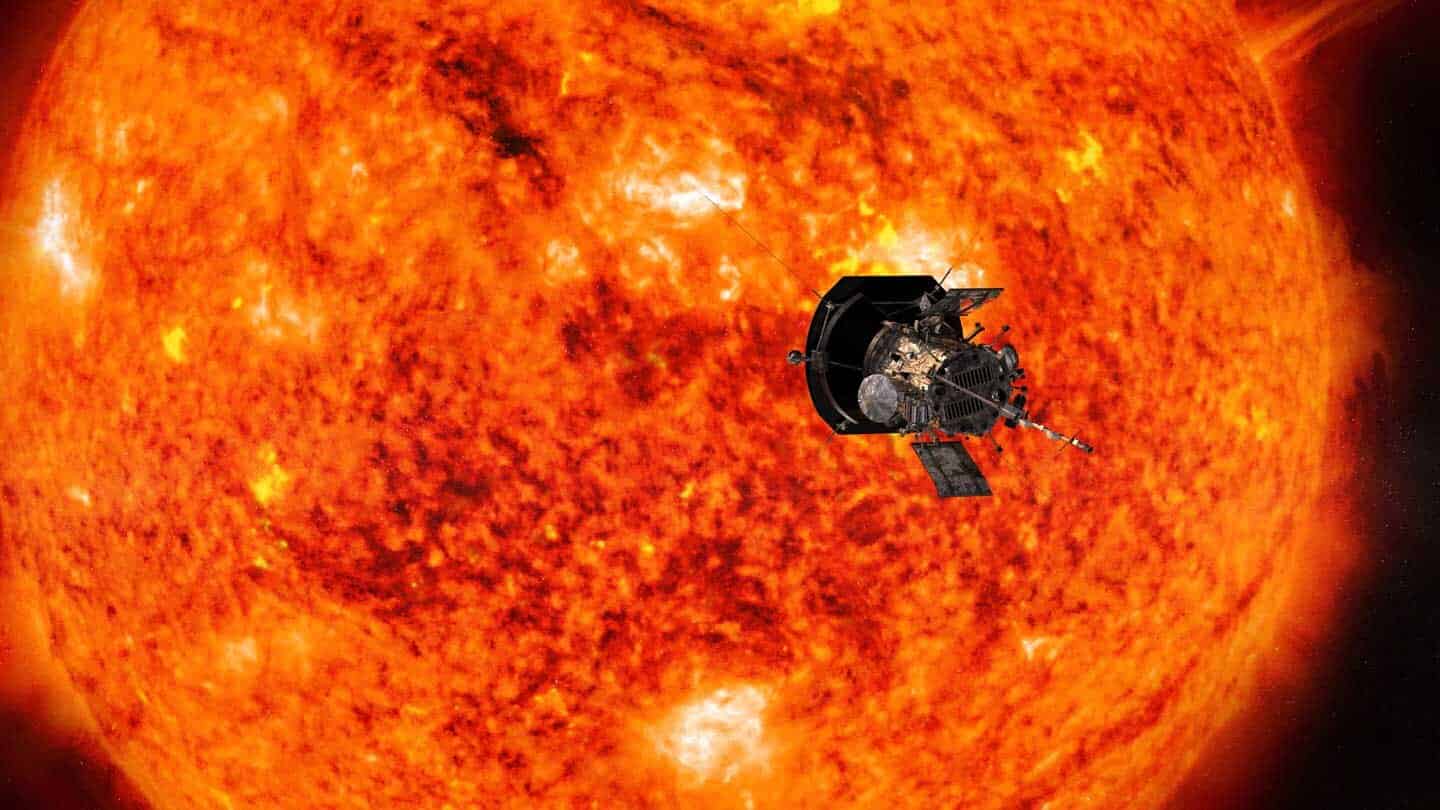
Using data from NASA’s Parker Solar Probe, researchers found that dust close to the Sun can alter plasma waves that carry energy through the corona and young solar wind, adding a new suspect to one of solar physics’ longest-running mysteries.
The Sun’s Waves
Scientists have treated the near-Sun environment mostly as a mix of electrons, ions, and magnetic fields. Dust seemed too fragile to have any impact there. The corona is brutally hot, and researchers expected many grains to vaporize before they could alter anything.
But data from the Parker Solar Probe would beg to differ. Although the spacecraft does not carry a dedicated dust detector, its FIELDS antennas can register dust indirectly. When high-speed grains strike the spacecraft, they vaporize and create small clouds of charged particles, which show up as voltage spikes. NASA says Parker’s instrument suites measure particles as well as electric and magnetic fields close to the Sun.
The team focused on kinetic Alfvén waves, a type of plasma wave that can carry electromagnetic energy and then pass it to particles. In plain terms, these waves can act like conveyor belts for heat.
“Our work adds a new ingredient to this picture: dust grains,” Syed Ayaz, the study’s lead author at the University of Alabama in Huntsville, said in a statement. “Before the Parker Solar Probe, dust was not usually considered an active part of coronal heating models because dust grains—a million times more massive than electrons/ions—were not expected to survive the high temperature of the solar corona.”
×
The study found that dust can push those waves in two directions. The weight of the dust can act like extra baggage. It slows the waves down, which means they may carry their energy farther through the corona before releasing it. The electric charge on the dust can do the opposite. It helps the waves interact more strongly with nearby particles, so the waves give up their energy faster. That energy can then heat the surrounding plasma.
The researchers focused on Parker Solar Probe data from around June 30, 2024, when the spacecraft was flying through a region about 6.3 million to 13.2 million kilometers (3.9 to 8.2 million miles) from the Sun’s surface—extremely close by space standards.
In that zone, the team found that dust was sparse but still strong enough to matter. Some grains carried enough electric charge to change how plasma waves handed energy to particles. Others added enough mass to slightly weigh the waves down. In the researchers’ model, both effects were large enough to change how fast the waves moved and where they released their energy as heat.
What It Means

The finding does not solve coronal heating by itself. It adds a missing factor to the scene.
If dust mass dominates, wave energy may travel deeper into the corona or into the young solar wind before it becomes heat. If dust charge dominates, the energy may be released closer to where the grains interact with the plasma. That difference could help explain why heating appears uneven and why the solar wind gains speed as it leaves the Sun.
But the Parker Solar Probe has no dedicated dust detector. The dust estimates depend on assumptions about impact rates, spacecraft collecting area, and the relative speed between spacecraft and grains. The work also relies on a model of how charged dust changes kinetic Alfvén waves, so dedicated dust instruments would help test the idea directly.
Still, the study opens a new route through an old puzzle. Parker has already flown closer to the Sun than any spacecraft before, including a record pass about 6 million kilometers (3.8 million miles) from the solar surface on Dec. 24, 2024, NASA reported.
Future missions with dust detectors and coordinated plasma-wave measurements could show whether these grains are only debris burning through the Sun’s outskirts—or whether they help decide where sunlight’s invisible energy becomes heat.
The study was published in The Astrophysical Journal.