For years, many archaeologists have argued that the first people to spread across the Americas survived by eating whatever each new landscape offered, from small game and fish to edible plants.
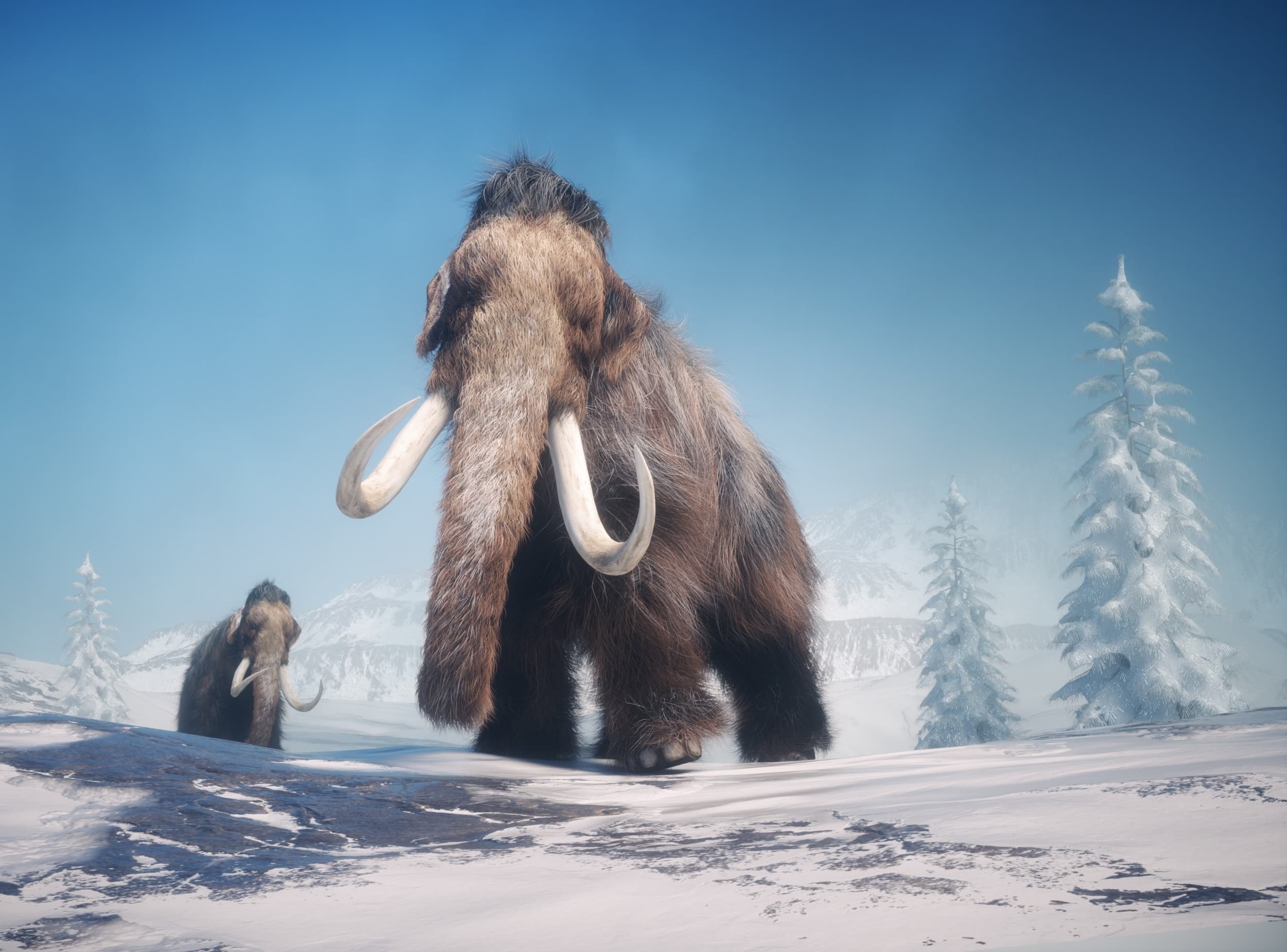
A new study reaches the opposite conclusion. Researchers found that Ice Age hunters overwhelmingly went after mammoths and other giant herbivores.
They carried the same specialized hunting strategy from Alaska to the southern tip of South America as they rapidly expanded across two continents.
The findings suggest that focusing on enormous prey, rather than adapting to each new ecosystem, may have been the key to one of humanity’s fastest migrations.
The results also revive the long-running idea that human hunting helped push many of those giant animals toward extinction.
Rethinking the first Americans’ diet
For decades, archaeologists have split into two camps over what the first Americans actually ate.
One side held that they were big-game specialists who sought out large herbivores.
The other argued they were generalists who took whatever an ecosystem offered, from rabbits and birds to fish and plants.
Ben Potter, an archaeologist at the University of Alaska Fairbanks (UAF), and James Chatters of McMaster University set out to test both ideas against the same body of evidence.
Records from continent-wide cultures
The researchers pulled together animal-bone records from the three oldest continent-wide cultures in the Americas.
Those three cultures stretch from one end of the hemisphere to the other. The oldest sites lie in Beringia, the ancient landmass that once joined Alaska and Siberia.
Next came the Clovis people of North America, known for their distinctive fluted stone spear points.
They were followed by South America’s Fishtail point makers, whose spear tips had a broad, flared base resembling a fish’s tail.
The team compiled 50 sites with well-preserved animal remains: eight in Beringia, 25 in North America, and 17 in South America.
At 49 of those 50 sites, the bones of large animals made up the majority of the edible meat. Only one site looked like the work of true generalists.
Within that large-animal category, the megaherbivores stood apart. These were animals weighing more than a ton.
Woolly mammoths dominated the Beringian diet, Columbian mammoths anchored the Clovis diet, and giant ground sloths and gomphotheres, distant relatives of elephants, dominated the South American diet.
By obtainable food weight, the pattern is stark. In every region, animals over a ton supplied roughly 83 to 88 percent of the calories early people could have gathered from their prey.
Smaller creatures barely registered, contributing well under one percent.
Could small prey be missing?
Critics have long had a ready objection, since small bones preserve poorly and could simply be missing from old sites.
To check, the researchers inflated the small-game numbers a hundredfold and ran the math again. Large animals still accounted for more than 98 percent of the food at Clovis sites.
Direct evidence backs the bone counts. A 2024 analysis of the only known Clovis individual, an 18-month-old child from Montana, reconstructed his mother’s diet by analyzing the chemistry of his bones.
Mammoths and other giants made up roughly 96 percent of her protein, while small mammals supplied about 4 percent.
Tools made for big prey
The tools tell the same story as the bones. Across all three regions, the toolkits centered on weapons and butchery gear for big animals, including large stone spear points, blades, and hide scrapers.
Hunters used a spear-thrower called an atlatl to launch darts deep into thick-skinned prey.
Just as telling is what these sites never contain.
Grinding stones for processing seeds are absent, as are earth ovens for cooking plants. No fishhooks, harpoons, or net sinkers have ever turned up either.
Evidence of careful planning
The stonework also shows careful planning.
Points were resharpened until too short to use, and toolmakers carried high-quality stone astonishing distances from its source.
In the central Great Plains, entire toolkits traveled as far as 370 miles, and one piece had come roughly 930 miles.
Hauling that much stone makes sense only for people constantly on the move, preparing in advance for prey they expected to meet anywhere.
A generalist mapping a small home territory would have little reason to stockpile gear from so far away.
Following giants across continents
Following giant animals turned out to be a strategy that traveled well. Mammoths and ground sloths ranged across enormous territories and many different habitats.
A hunter who learned their habits could move from tundra to grassland to tropical savanna and still find familiar game. Those skills carried over.
That, the authors argue, is how people crossed two continents in a few hundred years. Clovis points appear from Alberta to Venezuela within a span of perhaps 300 to 600 years, with nearly identical toolkits the whole way.
A generalist would have needed generations to learn each new ecosystem’s plants and small animals.
Southern hunters switched their prey
South of Panama, the menu changed but the logic held. As mammoths gave way to giant ground sloths and gomphotheres, southern hunters simply switched to the new giants.
A 2025 paper on southern South America found that extinct megafauna were the main prey there before about 11,600 years ago, once researchers stopped lumping older and younger sites together.
Potter and colleagues describe these people as dietary specialists but habitat generalists. Their diet stayed narrow even as the landscapes around them changed completely.
The skill was not knowing one place well, but knowing one kind of animal well.
A possible extinction connection
The same focus may carry a darker legacy. In each region, the favored giants vanished soon after people arrived and overlapped with them.
Woolly mammoths disappeared by about 13,400 years ago, Columbian mammoths by 12,800 years ago, and South America’s megafauna by about 11,600 years ago.
A 2021 study tied the South American extinctions directly to the spread of Fishtail points and rising human numbers.
Across the hemisphere, the researchers found evidence of human hunting for 28 of the 41 large-mammal genera that died out. That is most of them.
Many were keystone species whose grazing and trampling transformed whole landscapes, so losing even a few could ripple through entire food webs.
Whether hunting alone did the killing remains unsettled, and the climate was reshaping these environments at the same time.
The authors do not claim humans were the sole cause. They argue that the evidence makes it hard to rule human pressure out.
Ice Age hunters adapted to prey
What came next sharpens the picture. Once the giants were gone, the once-uniform cultures splintered into regional traditions tuned to local game.
Bison hunters dominated the Plains during the Ice age, caribou hunters spread across the Northeast, and hunters with smaller spear points pursued guanaco and deer in South America.
The specialists, in other words, finally became the generalists everyone had imagined them to be.
For a field that has argued the specialist-versus-generalist question for half a century, the breadth of the new analysis changes the terms of the debate.
It pulls Beringia, North America, and South America into one coherent account and pairs the bones with direct chemical evidence from an actual person.
The harder question now is not what these people ate, but how much their appetite for giants remade the living world they moved through.
The study is published in the journal Science Advances.
—–
Like what you read? Subscribe to our newsletter for engaging articles, exclusive content, and the latest updates.
Check us out on EarthSnap, a free app brought to you by Eric Ralls and Earth.com.
—–