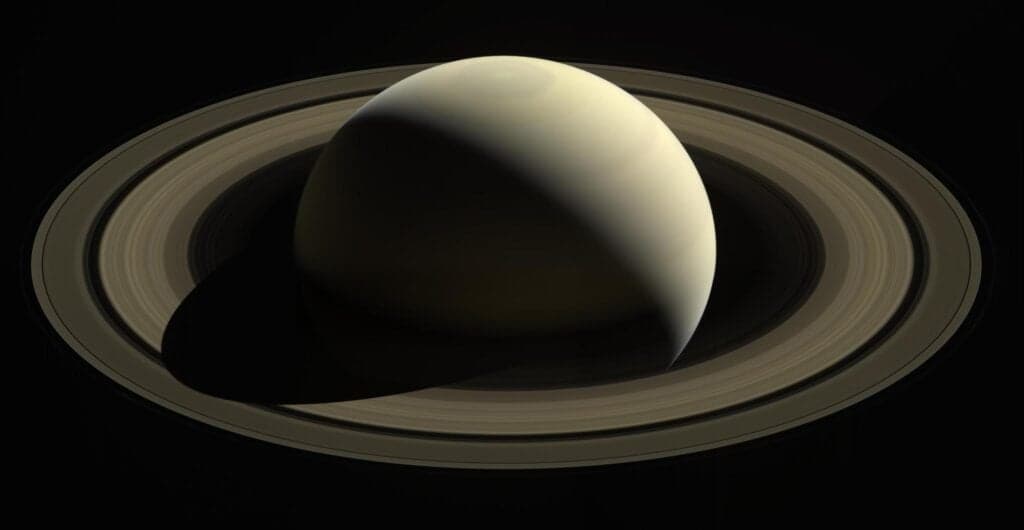
Saturn looks like the solar system’s old monument, a pale gas giant encircled by rings that seem as permanent as the planet itself. But one of the stranger conclusions to come out of the Cassini mission is that the rings may be much younger than Saturn, and perhaps young enough that they were absent for much of dinosaur history.
The planet formed with the rest of the solar system about 4.5 billion years ago. Its main rings, by contrast, may have been exposed to space for only tens to hundreds of millions of years, according to Cassini-era estimates based on their mass, brightness, composition and the rate at which they are being polluted and eroded.
That does not mean the question is settled. Ring age is one of the more stubborn arguments in planetary science. Cassini gave researchers the best measurements yet, but the same data can still be interpreted in different ways depending on how ring particles are cleaned, darkened, recycled or lost. Even so, the young-ring case remains a striking possibility: the Saturn we recognize may be a late version of Saturn, wearing a temporary system of icy debris.
A planet older than almost everything familiar
NASA describes Saturn’s rings as billions of pieces of ice and rock, from dust-sized grains to chunks as large as houses, with some particles even larger. The ring system extends as far as about 175,000 miles, or 282,000 kilometers, from the planet, while the main rings are typically only about 30 feet, or 10 meters, thick.
That scale makes the rings feel grand, but their material is fragile in geological terms. They are not solid hoops. They are a thin, orbiting sheet of particles moving around Saturn at different speeds, continually colliding, spreading, being struck by micrometeoroids and slowly losing material to the planet.
The age problem begins with how clean they are. Saturn’s main rings are bright because they are rich in water ice. If they had been circling the planet since the solar system’s youth, roughly 4.5 billion years, scientists would expect them to have collected far more dark, dusty material from interplanetary space. Instead, Cassini found rings that still look unusually fresh.
That freshness is what led researchers to ask whether the rings are not ancient survivors at all, but a relatively recent product of violence in the Saturn system.
Cassini weighed the evidence
Cassini reached Saturn in 2004 and ended its mission in 2017 by diving into the planet. During its final “Grand Finale” orbits, the spacecraft passed between Saturn and the rings, giving researchers a rare chance to measure the rings’ gravitational pull and therefore their mass more directly.
That mattered because ring mass changes the age calculation. A more massive ring system can absorb more dust without looking dirty. A lighter one reaches the same level of pollution faster. Cassini’s measurements, combined with the spacecraft’s dust detections and estimates of non-icy material in the rings, strengthened the case that the visible rings have not been exposed for billions of years.
In 2023, researchers working with Cassini-derived constraints argued that micrometeoroid flux, ring pollution and ring mass together limited the rings’ exposure age to less than a few hundred million years, assuming the incoming dust flux was broadly persistent. A companion study estimated that the rings may have a remaining lifetime of roughly 15 million to 400 million years, and suggested a revised pollution age of about 120 million years.
Those figures are why the dinosaur comparison is so jarring. Non-avian dinosaurs disappeared about 66 million years ago, and dinosaurs as a group first appeared more than 200 million years ago. If Saturn’s present rings are at the younger end of the Cassini-era estimates, they may have formed after much of the dinosaur era had already passed. If they are closer to a few hundred million years old, they could overlap more of that history, but they would still be a very recent feature next to Saturn itself.
The rings are also disappearing
The youth argument is not only about brightness. Cassini also showed that the rings are losing material to Saturn.
Some of that loss is often described as “ring rain”, a process in which ring particles become charged and are guided along magnetic field lines into the planet’s atmosphere. Cassini’s final measurements also pointed to large flows of material entering Saturn at lower latitudes. In the 2023 modeling work, micrometeoroid impacts and the transport of impact ejecta could help explain inward flows of ring material on the order of thousands to tens of thousands of kilograms per second.
In simple terms, Saturn’s rings are not just sitting there. They are being sandblasted, redistributed and drained. If that loss rate has been typical over long intervals, the rings cannot last forever. That makes a recent origin easier to imagine.
One possibility is that an icy moon or moons were destroyed by collision, tidal disruption or orbital instability. Simulations published in 2023 explored whether a collision between precursor icy moons, broadly analogous to Dione and Rhea, could have sent pure-ice debris inward, placing material inside Saturn’s Roche limit, where a moon cannot easily reassemble and a ring can persist. Other models have invoked a lost moon, sometimes called Chrysalis, whose destruction could help explain both Saturn’s rings and aspects of the planet’s tilt.
None of these scenarios is a finished origin story. They are attempts to match several clues at once: the rings’ icy purity, their low contamination, their measured mass, the structure of Saturn’s moons and the evidence that the rings are still evolving.
Why the debate is not over
The important caution is that “exposure age” and “formation age” are not automatically the same thing.
Exposure age asks how long the rings have been accumulating dust in a way that produces the contamination we see today. Formation age asks when the ring material first became a ring. If the rings can shed pollutants, bury dark material, vaporize incoming micrometeoroids or recycle icy particles more efficiently than earlier models assumed, then bright rings might look younger than they really are.
That caveat has become more visible in recent work. A 2026 reconsideration of Saturn’s ring exposure age argued that the standard dust-pollution argument depends strongly on uncertain parameters, including impact vaporization and space-weathering effects. A Japanese-led study reported in Nature Geoscience also challenged the idea that clean rings must be young, proposing that micrometeoroid impacts may vaporize much of the incoming material and leave little dark residue behind.
So the conservative answer is not that Saturn’s rings are definitely younger than dinosaurs. It is that Cassini made a strong case that the bright rings we see may be young by solar-system standards, perhaps tens to hundreds of millions of years old, while newer modeling continues to test whether their clean appearance could be misleading.
Either way, the implication is unsettling in the best scientific sense. Saturn’s rings are not simply decoration on an ancient planet. They are an active, temporary system whose past may involve destroyed moons and whose future may involve slow disappearance into the planet below.
If the younger estimates are right, then for most of Saturn’s 4.5-billion-year existence the planet may have looked profoundly different. The familiar ringed Saturn may be a recent scene, not a primordial one, and one that future astronomers may not always have the chance to see.
Sources
- NASA Science: Saturn Facts
- Durisen and Estrada, Large mass inflow rates in Saturn’s rings due to ballistic transport and mass loading
- Estrada and Durisen, Constraints on the initial mass, age and lifetime of Saturn’s rings
- Teodoro et al., A recent impact origin of Saturn’s rings and mid-sized moons
- Ricerchi and Crida, Saturn’s rings age I.: Reconsideration of the exposure age
- Associated Press: Study suggests Saturn’s rings may be older than previously thought