Physicists have developed a new way to control the rotation of molecules inside tiny droplets of liquid helium, marking an important advance in the study of superfluids. By using a specially designed optical centrifuge, the team was able to precisely spin molecules suspended in liquid helium nano-droplets, giving scientists a powerful new tool for exploring these unusual frictionless materials.
The achievement represents the first successful demonstration of controlled molecular rotation inside a superfluid. Researchers can now directly adjust both the direction and speed of a molecule's rotation, making it possible to investigate how molecules interact with their quantum surroundings at different rotational frequencies. The work, led by researchers at the University of British Columbia (UBC) in collaboration with the University of Freiburg, was published in Physical Review Letters.
"Controlling the rotation of a molecule dissolved in any fluid is a challenge," said Dr. Valery Milner, associate professor with UBC Physics and Astronomy and author on the paper.
"Dissolved molecules interact with the atomic or molecular constituents of the fluid, effectively getting bigger and harder to spin up. Imagine making a snowball: It's very easy to move it when it's small, but gets harder and harder as more snow gets attached to it."
Understanding Superfluids
Superfluids, such as liquid helium cooled to temperatures near absolute zero, are an unusual state of matter that flows without viscosity. Even though they have no internal friction, they still act as solvents, allowing molecules to dissolve within them.
"The question of interest in the science of quantum matter, and the one this new approach will help us explore, is what changes from the perspective of the solvated -- dissolved -- molecule when you make the transition from a normal fluid to this type of quantum superfluid," adds Dr. Milner.
A New Optical Centrifuge Technique
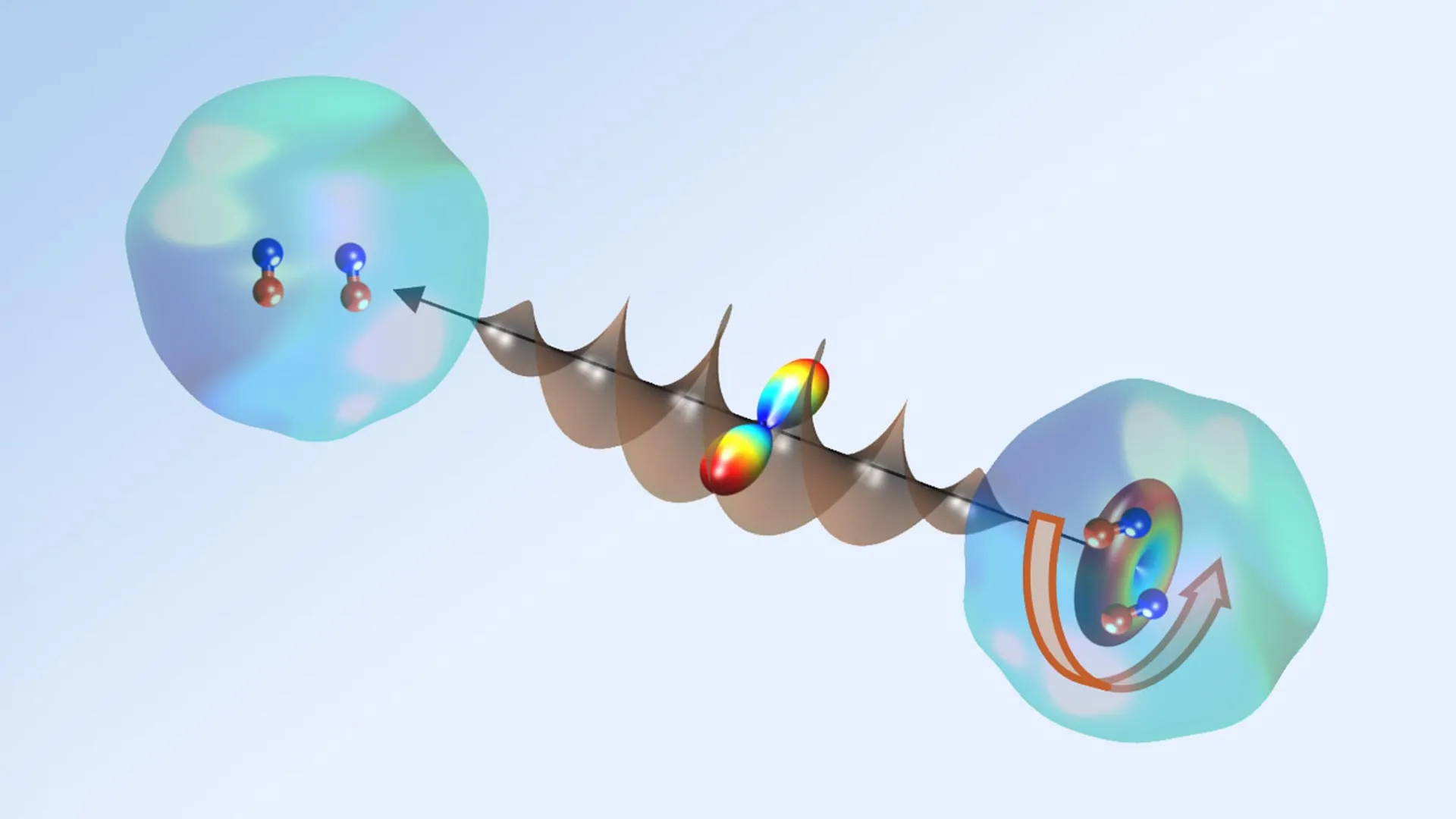
Traditional optical centrifuges have been used to spin molecules in gases by exposing them to a rotating laser pulse. As the laser's electric field rotates, gas molecules align with it and begin spinning. Until now, however, the same approach had not succeeded with molecules immersed in a superfluid.
To overcome that limitation, Dr. Milner and his colleagues embedded molecules in helium nano-droplets doped with dimers of nitric oxide. They then introduced a brief delay between laser pulses. The resulting interference produced a much slower, steady rotation rate that made the molecules easier to spin, increasing what the researchers describe as their "spinnability."
Exploring the Limits of Superfluidity
The researchers now plan to vary the rotation frequency (using the new 'control knob' offered by the novel centrifuge) to identify a critical point where molecular rotation is expected to slow dramatically because superfluidity begins to break down.
"It is not well understood how and when -- for example at what frequency -- this transition will happen at such a tiny atomic scale," says Dr. Milner. "That's the key area we're investigating at the moment."
The research was supported by the Natural Sciences and Engineering Research Council of Canada, the Canada Foundation for Innovation, and the BC Knowledge Development Fund.