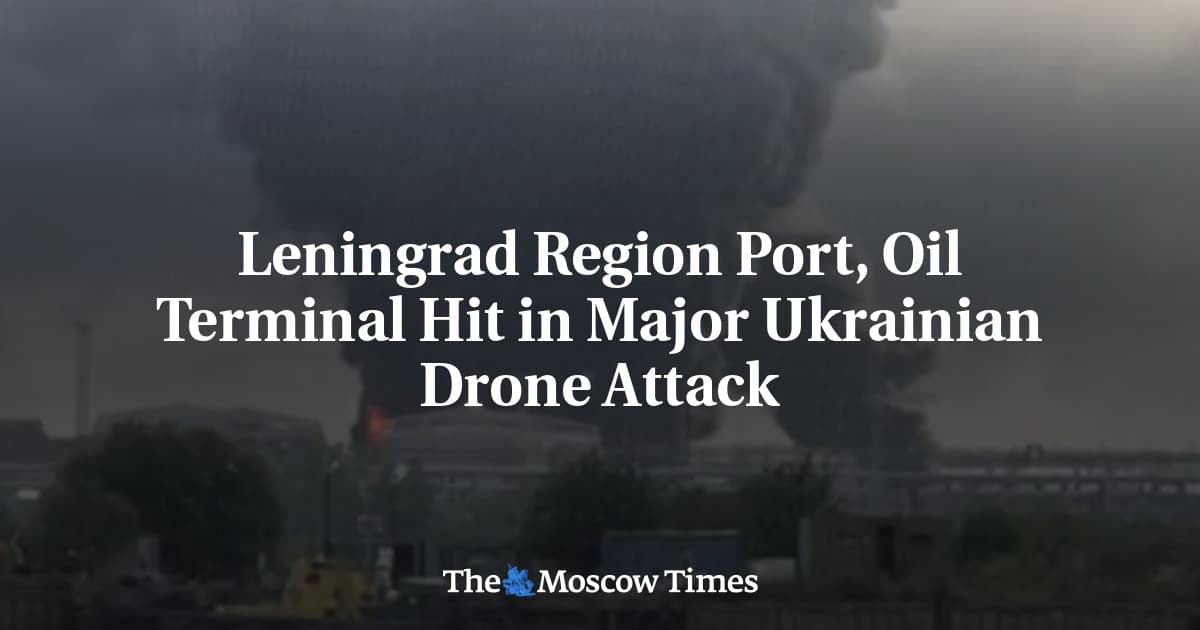
Russia's second city of St. Petersburg and the surrounding Leningrad region came under a large Ukrainian drone attack overnight on Saturday, with a local port and oil infrastructure struck, Russian and Ukrainian authorities said.
St. Petersburg Governor Alexander Beglov said the city of 6 million had been subjected to a "large-scale" drone attack, with the city's oil terminal struck. He said there were no casualties and that the aftermath of the attack had been dealt with.
Leningrad region Governor Alexander Drozdenko said drones had struck the port of Vysotsk, about 170 kilometers (105 miles) northwest of St. Petersburg on the Baltic Sea. The port handles oil, grain, coal and liquefied natural gas.
Drozdenko said 72 drones had been shot down over the Leningrad region.
In a post on Telegram, Ukrainian President Volodymyr Zelenskiy said: "Ukraine's defense forces struck port oil infrastructure that generates revenue for Russia's war, and also hit Kronstadt, an important military target more than 850 kilometers (528 miles) from Ukraine's state border."
There was no information from Russia on a strike on Kronstadt, a major naval base close to St. Petersburg that Ukraine hit in a previous attack on the city in June.
Ukraine has intensified strikes on Russian energy infrastructure this year, causing fuel shortages in parts of Russia.
Elsewhere, the governor of Russia's Bryansk region, as well as the Russian-installed governor of Crimea, said that drone strikes had killed one person in each region, with several more wounded.
South of St. Petersburg, the governor of the Pskov region said more than 30 drones had been shot down overnight. He reported minor damage and injuries, including to a factory in the town of Velikiye Luki.
A Message from The Moscow Times:
Dear readers,
We are facing unprecedented challenges. Russia's Prosecutor General's Office has designated The Moscow Times as an "undesirable" organization, criminalizing our work and putting our staff at risk of prosecution. This follows our earlier unjust labeling as a "foreign agent."
These actions are direct attempts to silence independent journalism in Russia. The authorities claim our work "discredits the decisions of the Russian leadership." We see things differently: we strive to provide accurate, unbiased reporting on Russia.
We, the journalists of The Moscow Times, refuse to be silenced. But to continue our work, we need your help.
Your support, no matter how small, makes a world of difference. If you can, please support us monthly starting from just $2. It's quick to set up, and every contribution makes a significant impact.
By supporting The Moscow Times, you're defending open, independent journalism in the face of repression. Thank you for standing with us.
Once
Monthly
Annual
Continue

Not ready to support today?
Remind me later.