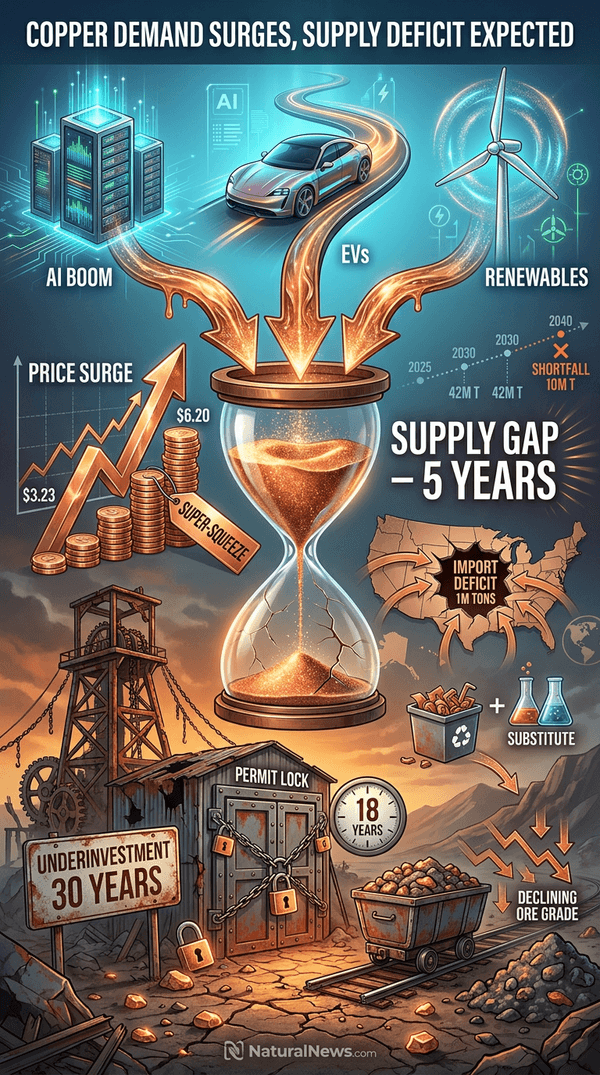
The ongoing artificial intelligence (AI) boom is driving a surge in copper demand that will lead to an unavoidable supply deficit within five years, according to veteran natural resource investor Rick Rule.
Speaking with Siyamak Khorrami on Epoch TV's "Market Insider," Rule said the increasingly energy-intensive lives of people worldwide have pushed up consumption of the industrial metal. With companies and countries investing heavily in AI, future demand for copper will be "staggering," he stated.
Rule said the world, and particularly the U.S., lacks enough copper development projects "in the pipeline," making a shortage and higher prices inevitable. "This is a capital-intensive, long-term business," Rule told Khorrami. "There is nothing we can do right now – nothing, not one thing – that will prevent a supply shortage within five years." [1]
Demand Projected to Outpace Supply
Global refined copper consumption rose to 28.2 million metric tons in 2025 from 25.8 million metric tons in 2022, according to the International Copper Study Group. Production increased to 28.6 million metric tons from 25.2 million metric tons over the same period, leaving a narrow surplus of 400,000 metric tons. However, a January S&P Global study predicts demand will reach 42 million metric tons by 2040, with a potential shortfall of about 10 million metric tons without "meaningful supply expansion." [1]
Copper prices have already reacted to tightening fundamentals. Futures on the New York Mercantile Exchange settled at $6.20 per pound on June 28, nearly doubling from the post-pandemic low of $3.23 per pound set on July 11, 2022. HSBC analysts have warned of a commodity "super-squeeze" and Goldman Sachs raised its year-end price targets for copper, reflecting broad institutional recognition of the supply-demand imbalance. [2]
U.S. Faces Growing Copper Deficit
The U.S. is a net copper importer, producing less than half of the refined copper it consumes. According to the U.S. Geological Survey (USGS), American production reached 850,000 metric tons in 2025 while consumption totaled 2.2 million metric tons, resulting in a deficit of more than 1 million metric tons. The country is expected to remain a net importer through 2040, with imported refined copper projected to account for about 70% of consumption, based on a June 23 SEC filing citing Wood Mackenzie data. [1]
In November 2025, the Department of the Interior added copper to the USGS' critical minerals list, joining materials deemed essential for economic and national security. Washington has also added silver to that list, reflecting growing concern over supply constraints across multiple industrial metals. [3] The copper tariff trade has further tightened global availability, with front-month Comex contracts trading more than $500 a ton above London Metal Exchange cash prices, levels not seen since autumn 2025. [4]
Under-Investment and Long Project Timelines
Rule said the copper industry has been "systemically underinvested in exploration, in construction, in development" for 30 years. Developing a new mine takes about 10 years to explore and find a deposit, three years to drill, three more years "in a good country" to secure a permit and funding and two years to build – approximately 18 years in total. [1] Many of the world's largest copper mines are aging and declining, with depletion rates accelerating. [5]
Wood Mackenzie estimated in a 2021 analysis that the world copper industry had committed around $120 billion in capital spending to maintain production at the time. The analysis said that without additional substantial investment, production will decline from 2024 onward, leading to a theoretical shortfall of around 16 million metric tons by 2040.
To close the gap, the analysis estimated the industry would need about $325 billion in additional investment. [1] Rule added that if data center demands from companies like Google and Amazon materialize as projected, "we will need to produce more copper between 2026 and 2050 – 24 short years – than has been mined in the history of mankind." [1]
Permitting Process Delays Projects
Rule said there are currently few construction-ready projects due to decades of underinvestment in mineral exploration. In the U.S., the permitting process is a major hurdle. The Resolution Copper project in Arizona, jointly owned by Rio Tinto and BHP, has been waiting more than a decade for a permit. The deposit was officially discovered in 1995, began the permitting process in 2013, and released its Final Environmental Impact Statement in 2019. [1]
According to Rio Tinto, if developed, Resolution Copper could be one of the largest copper mines in the United States, potentially supplying up to one-quarter of U.S. copper demand. [1] Rule said the situation points to a clear conclusion: "All of this points to the fact that we're going to have to get used to higher copper prices." [1]
Conclusion: Structural Shortage Reshapes Market Outlook
The convergence of surging AI-driven demand, decades of underinvestment and protracted permitting timelines has created a structural supply deficit that analysts say cannot be resolved quickly. Even at elevated prices, new mine development takes nearly two decades, meaning the current shortfall will persist and likely worsen.
Jefferies analyst Christopher LaFemina recently wrote that the firm "wasn't bullish enough on copper," citing explosive growth in AI data center buildouts and grid upgrades. [6] Rule emphasized that the industry is entering a copper construction cycle, acknowledging that $6 per pound provides an incentive for new projects.
However, the lag between investment and production means that near-term shortages are locked in. For investors and consumers alike, higher copper prices appear to be a permanent feature of the global economy, driven by physical reality rather than speculative excess.
References
- Mary Prenon. "Copper Demand Surges, But Supply Deficit Is Hard To Solve, Expert Says." ZeroHedge. July 1, 2026.
- HSBC and Goldman Sachs. "HSBC Warns Of Commodity 'Super-Squeeze' As Goldman Hikes Copper Forecasts." ZeroHedge. June 2, 2026.
- Chris Martenson. "When the AI Bubble Pops The Fallout Few Expect." PeakProsperity.com. November 24, 2025.
- NaturalNews.com. "Copper Tariff Trade Tightens Global Supply." May 31, 2026.
- Daily Reckoning. "A Huge 'Problem' in the Copper Industry." February 28, 2026.
- Jefferies analyst Christopher LaFemina. "Jefferies: 'Turns Out, We Weren't Bullish Enough On Copper'." ZeroHedge. June 9, 2026.
- Harry Browne. "You can profit from a monetary crisis."
Explainer Infographic