- Which vaccines are in use in South Africa, and how does our vaccination schedule measure up to international standards?
- In this special briefing, Spotlight unpacks the recent history and details the vaccines being used in the country.
- Vaccines work by exposing one’s body to a harmless part or form of a disease-causing pathogen.
Globally, childhood vaccines have saved an estimated 154 million lives since 1974. That is the year in which the World Health Organisation (WHO) launched its Expanded Programme on Immunisation (EPI). It provides guidance to countries about which vaccines should be provided universally through countries’ national health systems.
A vaccine recommended for “universal” use means that all children should receive this vaccine unless they have a contraindication – a medical reason that means they should delay or not receive certain vaccines. The WHO’s EPI programme also provides recommendations for vaccines that are needed to prevent regionally specific disease threats.
Back in 1974, the WHO recommended that countries universally vaccinate against six infectious diseases: tuberculosis, polio, measles, pertussis, tetanus, and diphtheria. The WHO subsequently expanded its guidance to recommend universal vaccination against an additional seven disease-causing pathogens. These are hepatitis B, Haemophilus influenzae type b (Hib), pneumococcal disease, rotavirus, rubella, human papillomavirus (HPV), and respiratory syncytial virus (RSV).
Vaccines work by exposing one’s body to a harmless part or form of a disease-causing pathogen. This triggers the body’s natural immune response to produce protective immune cells that can fight off future infection or disease caused by the pathogen. Disease-causing pathogens include both viruses and bacteria.
Before 1974, South Africa was already using vaccines to prevent disease, including vaccines against smallpox (which was eliminated globally in the 1980s), tuberculosis, and polio. In 1974, South Africa introduced vaccines against tetanus, pertussis, diphtheria and measles. However, before 1995, access to vaccines was highly inequitable across South Africa’s fragmented Apartheid healthcare system.
South Africa launched its unified national immunisation programme in 1995. This programme offers free vaccines to all children in the country, although many people who can afford private health services (around 16% of the population) still pay to get their children vaccinated at private clinics rather than seek childhood vaccines from often overcrowded and under resourced public facilities.
Today, the national programme offers children vaccinations against twelve of the thirteen disease causing pathogens the WHO recommends. The one WHO-recommended jab missing from our programme is that for RSV.
READ | Cape factory to develop vaccines from scratch as IDC, EU commit big money
Vaccines save the lives of children
There is compelling evidence that South Africa’s vaccination programme has saved many lives. In 1974, 132 of every thousand children born in South Africa died before their fifth birthday. Today, that number is at 35. Vaccines are not the only reason for this improvement, but the scientific evidence is clear that it was a major contributor.
In a major modelling study published in the Lancet medical journal, researchers estimated that 40% of the global decline in childhood deaths observed since the 1970s was attributable to vaccines. In Africa, they found that vaccines contributed to over half (52%) of the reduction in childhood deaths.
Other important interventions that have reduced childhood deaths over the past fifty years include expanded access to safe drinking water and sanitation, advances in maternal and newborn care, improved access to health services, and in this century, HIV treatment and prevention services.
While deaths among children under five have greatly fallen over the past 50 years in South Africa, the country’s under-five mortality rate remains higher than the Sustainable Development Goal to bring under 5 deaths below 25 for every thousand children born by 2030.
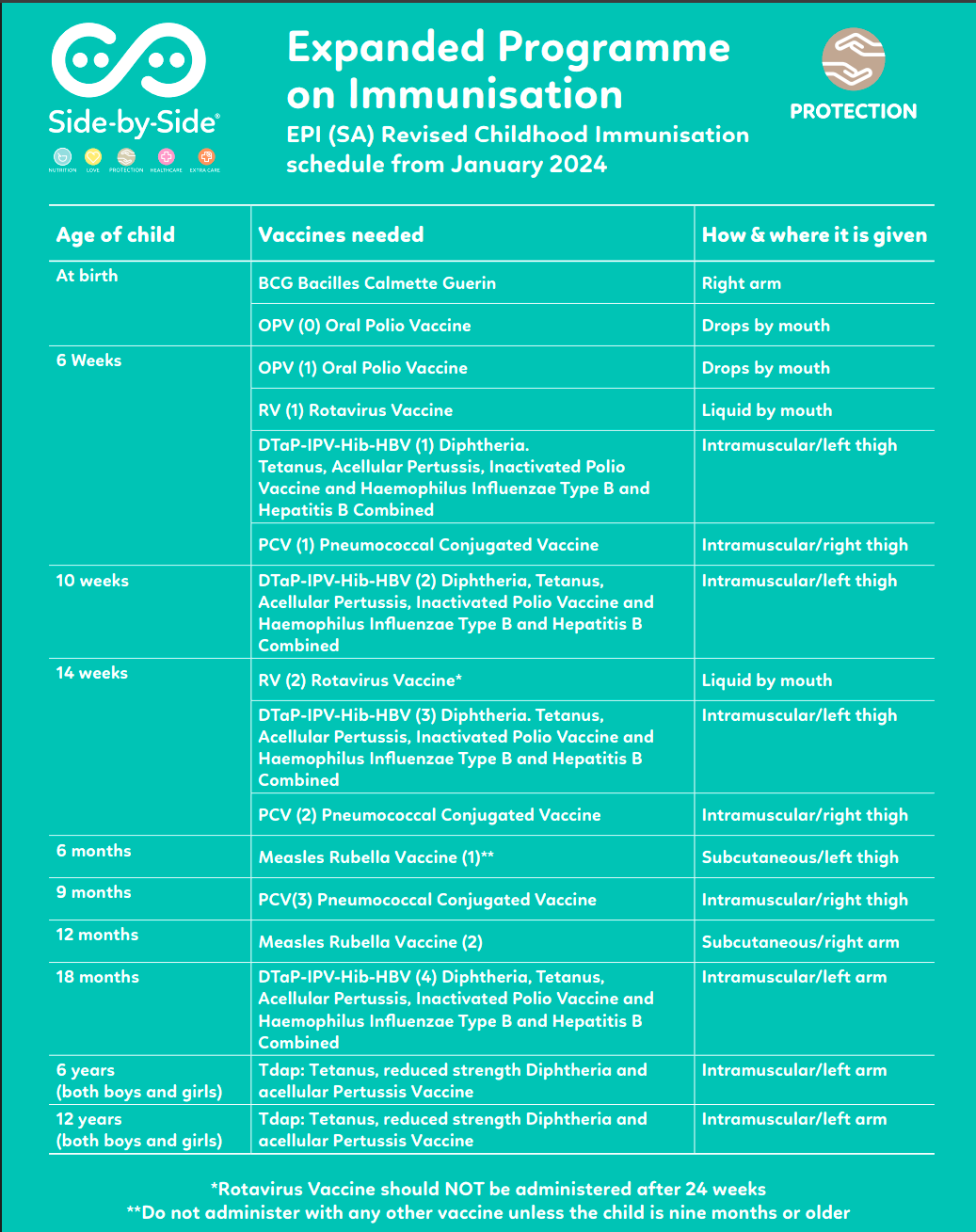
Expanded programme on immunisation.
Spotlight/Supplied
One serious concern is that vaccination rates in South Africa appears to be falling. South Africa’s 2024/2025 District Health Barometer, published in April 2026, showed that only 75.1% of children in South Africa had received all recommended vaccines by their first birthday in 2024/2025 – down from 83% five years earlier. (A previous Spotlight special briefing asked why South Africa’s immunisation rates are so low and what can be done about it.)
Falling vaccination rates have already resulted in increased numbers of vaccine-preventable illnesses in young children in South Africa. In November 2025, the Western Cape health department said: “South Africa is currently facing a decline in childhood vaccination uptake which poses a serious risk for public health and threatens the country’s efforts to eliminate vaccine preventable diseases.” It added: “This decline contributed to multiple outbreaks of measles, rubella, and diphtheria across the province, signalling serious gaps in population immunity.”
What is needed for a vaccine to be rolled out in South Africa?
Before a vaccine is rolled out in South Africa, it must be evaluated for its safety, effectiveness, and quality. Determining this is the responsibility of the South African Health Products Regulatory Authority (SAHPRA). It reviews large amounts of data and considers multiple factors, including clinical trial results and the standards and procedures under which a vaccine is made. SAHPRA approval amounts to a green light for the marketing of a vaccine in South Africa – but that does not necessarily mean that the National Department of Health will procure the vaccine.
The body responsible for advising the health department on which vaccines to provide is called the National Advisory Group on Immunisations (NAGI). It also advises the health department on how vaccines should be rolled out. For example, whether their use should be targeted only at children at high-risk of certain diseases or provided to all children.
NAGI, according to the health department, brings together “experts from different fields involved in vaccinology and immunisation to advise and guide the National Department of Health to implement an effective immunisation programme in keeping with current international standards and development”.
ALSO READ | Large vaccine plant in Cape Town wins R1.4bn from Europe
South Africa’s national vaccine schedule is informed by and closely aligned with the WHO’s vaccine schedule, but as in other countries, the decisions about which vaccines to offer are taken locally. For example, the WHO recommends vaccinating pregnant mothers against RSV, but as of the time of writing, this has not been taken up in South Africa’s public sector.
It is ultimately the health department that decides whether vaccines will be rolled out in the public sector. After a decision is made by the health department, based on NAGI’s recommendations, the health department must “formally inform the Chair of NAGI of the decision for feedback to the whole committee”.
The health department is then responsible for procuring the vaccines and rolling them out to clinics and schools across the country. The health department buys these vaccines through national tenders that are advertised and awarded every three years.
Targeting 12 childhood diseases
South Africa’s health department aims to vaccinate at least 90% of children against twelve disease-causing pathogens: polio, tuberculosis, measles, pertussis, diphtheria, tetanus, hepatitis B, Hib, pneumococcal disease, rotavirus, rubella, and HPV (only girls).
Children in South Africa should receive their first vaccines, against tuberculosis and polio, within a few hours of birth and complete all their childhood vaccines by around the age of 12. Vaccines used in South Africa include combination vaccines that provide protection against multiple diseases, as well as stand-alone vaccines that only target a single disease. (See Spotlight’s detailed guide to childhood vaccines for details on all of them.)
Most childhood vaccines require more than one dose to provide their full protective benefits, and dosing schedules are spaced across weeks, months and even years.
While South Africa provides vaccines against 12 of the 13 childhood illnesses targeted for universal vaccination by the WHO, it does not yet provide birth dose vaccines against hepatitis B to all infants born in the country or maternal vaccines against RSV, as recommended by the WHO.
South Africa’s health department provides free childhood vaccines at public clinics, as well as schools (for vaccines given to school-age children). Parents must sign consent forms for the children to be vaccinated at schools.
How things differ in the private sector
In addition to the 12 diseases targeted by South Africa’s health department, children receiving care in the country’s private health sector may also be vaccinated against hepatitis A, meningococcal disease, mumps, chicken pox, and seasonal influenza.
However, caregivers who take their children to private clinics for their childhood vaccines may be surprised by the high costs of many vaccines administered through the private sector and the limited coverage provided for vaccines from their medical aid schemes, including for vaccines recommended for universal use by the health department.
Completing a child’s full recommended vaccine schedule at private vaccination clinics (typically mom and baby clinics and travel clinics) costs thousands of rands, and medical schemes often reject coverage for childhood vaccines on the basis that they are not required to cover vaccine costs since they are not prescribed minimum benefits. Prescribed minimum benefits are the health services that medical schemes are legally required to provide coverage for.
READ MORE | Early flu season hits SA again: Why vaccination and clean hands are your best defence
In response to a question regarding the requirements for coverage of vaccines’ cost by private medical schemes in South Africa, the Council for Medical Schemes’ (CMS) spokesperson, Stephen Monamodi, told Spotlight: “Childhood vaccinations are not considered a prescribed minimum benefit (PMB) and are therefore not legally required to be covered by medical schemes.”
Monamodi added that while medical schemes are not currently required to cover the costs of childhood vaccines for their members, “the CMS is currently working on a primary health care basket of services, which includes preventive health services such as health screenings and childhood vaccinations, as part of the offering to be considered as part of the PMBs”.
The way forward
As we’ve shown in this Spotlight special briefing, South Africa has an appropriately ambitious national immunisation programme. Most of the vaccines recommended by the World Health Organisation are provided here free of charge through public clinics and schools. These are life-saving public health achievements that should not be taken for granted.
But some gaps remain in the national immunisation schedule compared with international recommendations. For example, vaccines against RSV are not yet routinely provided, even though RSV can cause severe and sometimes fatal illness in young infants. Hopefully these gaps will be closed soon.
READ | Gates-backed vaccine firm opens new Cape Town lab
Much more worrying than these gaps, however, is the fact that immunisation rates in South Africa have fallen in recent years. This has left far too many children vulnerable to vaccine-preventable diseases and related complications.
Our childhood immunisation programme has been one of the country’s biggest public health success stories of recent decades. In terms of the vaccines provided it remains excellent, but the fact that immunisation rates are lower than they should be is setting off very loud alarms. Let’s hope it is heard in the corridors of power. Many children’s lives literally depend on it.
*This special briefing is part of a series by Spotlight – health journalism in the public interest. Sign up to the Spotlight newsletter.